
By Chris Mambu Rasch, Executive Director
 With the November election results behind us, Wisconsin is preparing for a major political shift. In January 2027, Democrats will assume control of the Governor’s office, the State Assembly, and the State Senate. For the first time in sixteen years, the democrats will hold a governing trifecta in Madison—and for the union construction industry, this signals a period of rapid, consequential policy change.
During the first 100 days of the new legislative session, we expect lawmakers to move quickly on a robust slate of labor-focused priorities. Among the policies anticipated to be at the forefront are:
- The repeal of Right to Work
- The restoration of prevailing wage laws
- Apprenticeship utilization requirements
- Stronger protections against worker misclassification and payroll fraud
- Statewide responsible bidder provisions
- Lifting bans on Project Labor Agreements (PLAs), and
- Major public infrastructure investments tied to strong labor standards
A Tremendous Opportunity for Labor and Management Alike
At its core, this new legislative landscape presents a tremendous opportunity for our entire industry—not just for our building trades unions, but for our signatory union contractors as well.
For years, responsible union contractors have had to compete on an uneven playing field against low-road operators who cut corners on wages, benefits, training, and worker classification. Policies that level that playing field—such as restoring prevailing wage, cracking down on payroll fraud, and tying public infrastructure dollars to high labor standards—directly benefit union management. When quality, safety, and fair compensation are the baseline for public and private work, our signatory contractors are positioned to win more bids, grow their businesses, and put more skilled tradespeople to work.
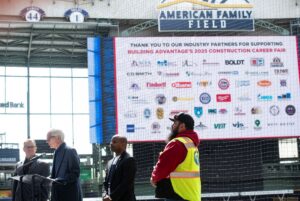 As a labor-management association, our mission is to advance our shared goals and grow market share for the union construction industry. Because we represent both sides of the table, we recognize that when our overarching goals are aligned, labor and management are a powerful force. Wisconsin’s union construction industry has long demonstrated that labor and management can work together in pursuit of common objectives. The changing political environment does not alter that mission. If anything, it reinforces the importance of it.
This is where the strength of our labor-management model shines. Because we have built a foundation of trust and open communication between our trades and our contractor associations, we have a direct line to the decision-makers shaping these policies.
As we enter 2027, our industry has an opportunity to speak with a stronger voice, showcase the advantages of our training and workforce development systems, and help policymakers understand how investments in skilled construction labor can strengthen communities, expand economic opportunity, and deliver critical infrastructure throughout Wisconsin.
January 2027 will mark the beginning of a fast-moving chapter in state politics. By staying engaged, communicating openly, and leaning into our labor-management partnership, we can ensure that the policies coming out of Madison translate into lasting growth, fair competition, and historic opportunities for Wisconsin’s union construction industry.